Faceless YouTube Channel Truths for 2026
Start a faceless YouTube channel the smart way in 2026: pick niches with real demand, protect your RPM, test formats fast, and build systems that scale.
· 6 min read · YT Outlier
Most advice about starting a faceless YouTube channel sells a fantasy: pick a niche, press a few AI buttons, collect checks. The reality is less glamorous and far more predictable. Channels that win in 2026 follow a handful of unsexy rules about niche selection, watch time, monetization, and systems. Channels that lose usually break the same few rules.
Here's the playbook, minus the hype.
Stop Guessing Your Niche. Validate It.
Niche paralysis kills more channels than bad editing ever will. Creators spend weeks brainstorming YouTube niche ideas in a notebook when the answer is already sitting on the platform.
A practical validation filter looks like this:
- Demand: the niche already has channels pulling at least 700K views per month.
- Freshness: some of those channels started less than 90 days ago.
- Ceiling: there's a realistic path to 1.5M views per month.
The freshness check is the one most people skip, and it matters most. A niche full of ten-year-old giants tells you the topic works. A niche where brand-new channels are breaking out tells you the topic works right now, for newcomers. That's the signal you want.
This is exactly what YT Outlier is built for. Instead of scrolling for hours, you can surface breakout channels and outlier videos, check each channel's age to confirm it's genuinely new, and look at estimated earnings to see whether the views actually turn into money. A young channel with strong views and healthy estimated earnings is a validated niche. A young channel with views but weak earnings is a warning.
Copy the Format, Not the Video
Replicating what works is how most successful faceless channels start. But blind cloning gets you nowhere: you end up with a weaker version of something viewers have already seen.
The smarter approach:
- Break down the structure. Hook length, pacing, narration style, visual rhythm, video length, title pattern.
- Keep the skeleton. That structure is what the algorithm and the audience have already approved.
- Add your angle. A different sub-topic, a sharper point of view, better research, or a new visual style.
Use outlier videos as your reference set: when one upload massively outperforms a channel's usual numbers, its format or packaging struck a nerve.
Watch Time Beats Percentage Viewed
Many creators obsess over average percentage viewed (AVP). It's the wrong metric to worship. Average view duration (AVD), the actual minutes watched, is what matters more.
Do the math:
- A 60-minute video at 15% AVP = 9 minutes of watch time per view.
- A 6-minute video at 50% AVP = 3 minutes of watch time per view.
The "worse" retention percentage delivers three times the watch time. YouTube wants viewers on the platform as long as possible, so the longer session is the more valuable one.
This ties directly into monetization:
- At 8 minutes, you unlock mid-roll ads.
- At lengths like 120 minutes, you can fit far more mid-rolls.
More ad inventory means more revenue for YouTube, and more revenue shared with you. If your niche supports long-form content (sleep, ambience, deep-dive documentaries, compilations), length is a lever. Use it.
RPM Is the Metric That Pays the Bills
Views are the vanity number. RPM, revenue per 1,000 views, is the business number.
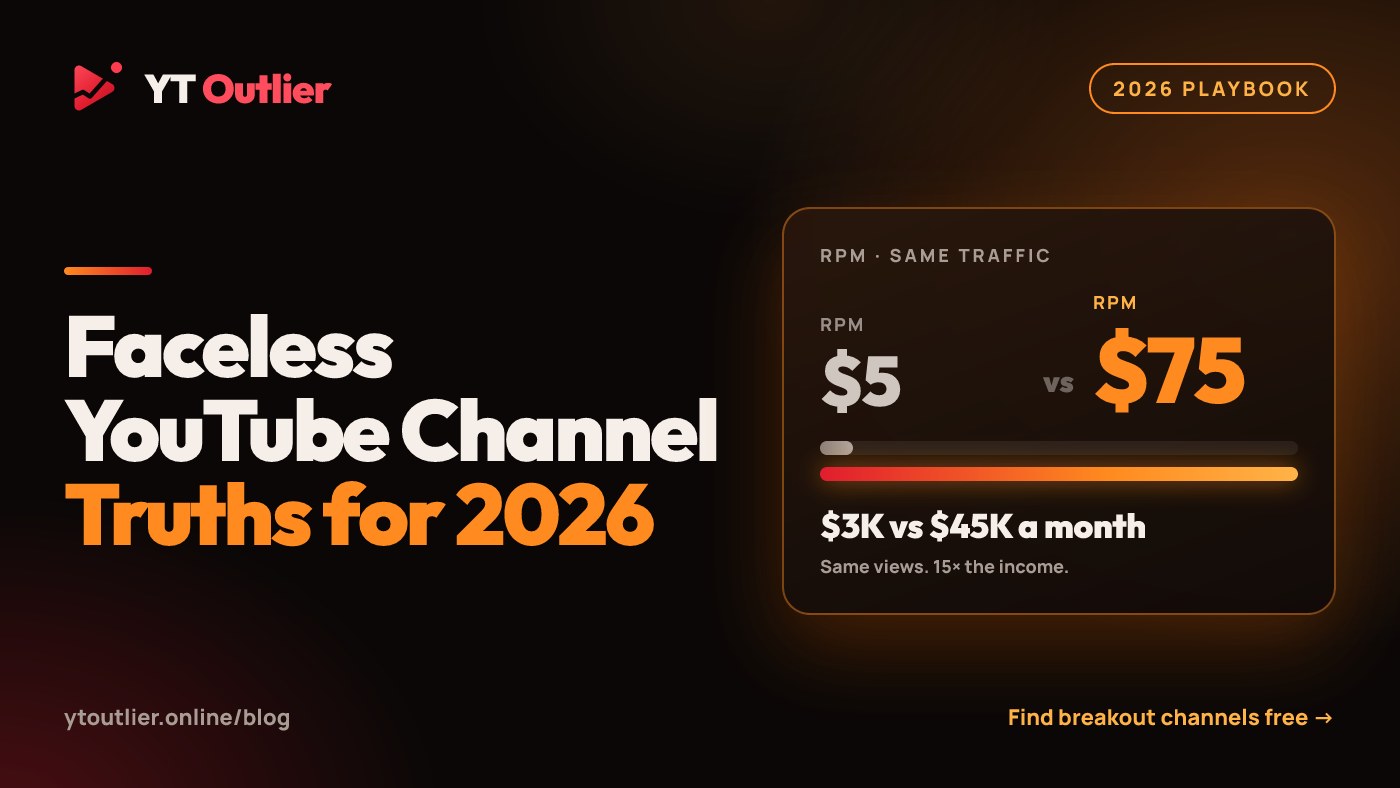
Consider two channels with identical traffic: one earns a $5 RPM, the other a $75 RPM. That gap is the difference between roughly $3,000 per month and $45,000 per month. Same views. 15x the income.
That's why niche selection and RPM can't be separated. Before you commit to a niche, check what comparable channels are likely earning. YT Outlier's estimated earnings let you compare niches on income potential, not just view counts, so you don't spend six months building an audience that advertisers don't pay much for.
Thumbnails Are Half the Battle
No click, no view. No view, no watch time, no RPM, no revenue. Your script, voiceover, and edit only matter if someone chooses your video over everything else in their feed.
Treat packaging as half the job:
- Design the thumbnail and title before you produce the video.
- Pull reference thumbnails from outlier videos in your niche and note what they share: contrast, faces or objects, text length, emotion.
- Test variations and keep a swipe file of what earns clicks.
Test in Batches, Not Single Uploads
One upload tells you almost nothing. A real test needs volume:
- For most faceless formats, plan for 10–15 videos before judging a concept.
- For sleep-style channels, that test can easily stretch to 30 videos.
Then judge the batch: did any videos break out? Did a specific topic or title pattern outperform the rest? Double down on what's working and cut what isn't.
Expect your first niche to fail, often your second too. Many creators find their winner on the third, fourth, or fifth attempt. The only guaranteed way to lose is to stop.
Consistency Wins More Than Talent
Most channels don't die because the videos are bad or the niche is "saturated." They die because the creator quits.
The low barrier to entry cuts both ways. Anyone with $50 and an internet connection can start, so competition keeps rising. But most of that competition uploads low-quality videos and gives up early. If you keep publishing and keep improving each upload, you outlast most of the field by default.
You're rarely too late to a niche. You're usually too slow. Faceless channels are breaking out right now with simple formats because their owners shipped while others planned. Sort YT Outlier by young channels and you'll see the evidence.
Budget Honestly: "Free" Automation Isn't Free
"Start a YouTube channel for $0 with AI" is marketing, not a business plan. A basic faceless stack (scripting, voiceover, and video generation or editing tools) runs at least $50 per month, before you hire anyone.
Plan for that cost from day one, and validate your niche with real data before you spend it.
Diversify Before You Need To
A single channel is a single point of failure. If YouTube changes how it treats a category, such as sleep content, a one-channel operator can drop to zero overnight.
Spread your risk across:
- Multiple channels
- Different niches
- Different formats (long-form, compilations, Shorts)
Be especially careful with political and news channels. They can go viral and earn $50K+ per month, but a ban can mean YouTube doesn't pay out what you've earned, and your AdSense account can be affected too. High reward, high fragility.
Build Systems, Then Build a Team
If your editor keeps delivering weak videos, the problem is usually your process, not the editor. Teams only scale as far as your systems do.
Write SOPs (standard operating procedures) for every repeatable task:
- Scripting guidelines and hook templates
- Voiceover and pacing standards
- Editing checklists and thumbnail briefs
- Loom walkthroughs for anything visual
Good SOPs mean consistent output, easier hiring, and a channel business that could one day be sold. Treat this as a business, not a side hustle. Start with 1–2 focused hours a day to learn the fundamentals, then scale your hours as results come in.
The Faceless YouTube Channel Checklist
- Find young breakout channels with real demand (700K+ monthly views, started under 90 days ago).
- Check estimated earnings to confirm the RPM is worth chasing.
- Copy the winning structure, then add your own angle.
- Go long where the niche allows it: optimize for minutes watched, not percentages.
- Design the thumbnail first.
- Test in batches of 10–15 videos (up to 30 for sleep content).
- Budget at least $50/month for tools.
- Diversify across channels, niches, and formats.
- Document everything in SOPs before you hire.
Find Your Next Breakout Niche With YT Outlier
Every step above starts with the same question: what's working right now, for channels like mine? YT Outlier answers it in minutes. It surfaces outlier videos and breakout channels, shows each channel's age so you can spot fresh opportunities, and estimates earnings so you can pick niches that actually pay.
Stop guessing. Start your research at ytoutlier.online and build your faceless YouTube channel on data, not hope.