YouTube Outlier Tool Free: How to Find Outlier Videos (Beginner's Guide)
New to YouTube research? Learn what an outlier video is, how the outlier ratio works, and how to find outliers for free with YT Outlier.
· 9 min read · YT Outlier
Quick answer: A YouTube outlier is a video that gets far more views than its own channel normally gets. You find one by dividing the video's views by the channel's median views. A result of 3× or higher on a channel with real traffic is worth studying. A free YouTube outlier tool like YT Outlier does this math for you.
In this guide:
- What is an outlier video?
- How the outlier ratio works
- A worked example
- Why age and format matter
- How to avoid misleading numbers
- How to check an outlier manually
- How to use outliers ethically
- What you get free with YT Outlier
- A 5-step routine for beginners
- FAQ
What is a YouTube outlier video?
Every channel has a "normal" number of views. Most uploads land close to it. Every so often, one video blows past it, sometimes by five or ten times. That video is an outlier.
Outliers are some of the most useful research material a new creator can find. They show which topic, title, or format a specific audience reacted to far more than usual. You can use that to choose better video ideas instead of guessing.
An outlier is not simply a video with lots of views:
- 2 million views is ordinary on a channel that averages 3 million.
- 40,000 views is extraordinary on a channel that usually gets 4,000.
So an outlier is always measured against that channel's own baseline, not against all of YouTube. Every video outlier tool is built on this idea.
How the outlier ratio works
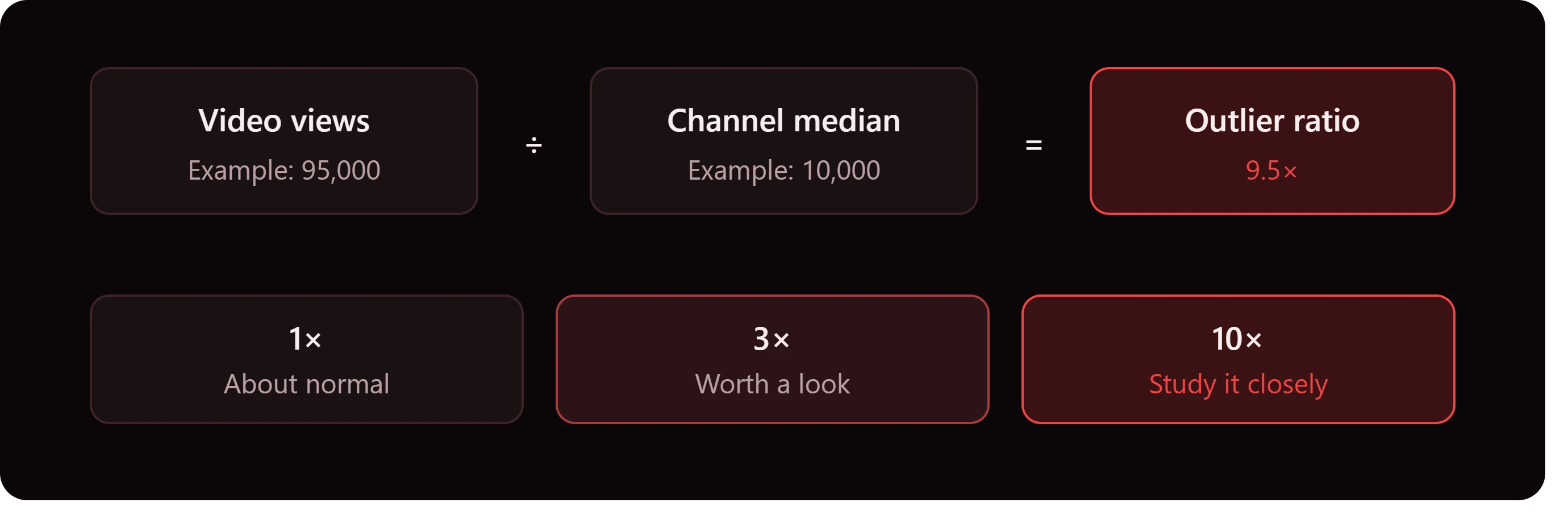
Outlier ratio = a video's views ÷ the channel's median views
| Ratio | What it means |
|---|---|
| 1× | About normal for this channel |
| 3× | Three times the usual views, worth a look |
| 10× | Something unusual happened, so study it closely |
YT Outlier calculates its outlier multiplier by dividing a video's views by the median views of the channel's recent uploads that it samples.
New to the term? A median is the middle value when you sort a list from lowest to highest.
Why median and not average?
The average gets dragged upward by the very videos you are trying to find. The median barely moves when one video goes viral, so it gives a truer picture of "normal."
A worked example (hypothetical numbers)
The channel and figures below are invented to show the math. They are not real data.
Imagine a small history channel with these recent uploads:
| Video | Views |
|---|---|
| A | 6,000 |
| B | 8,000 |
| C | 9,000 |
| D | 10,000 |
| E | 12,000 |
| F | 14,000 |
| G | 95,000 |
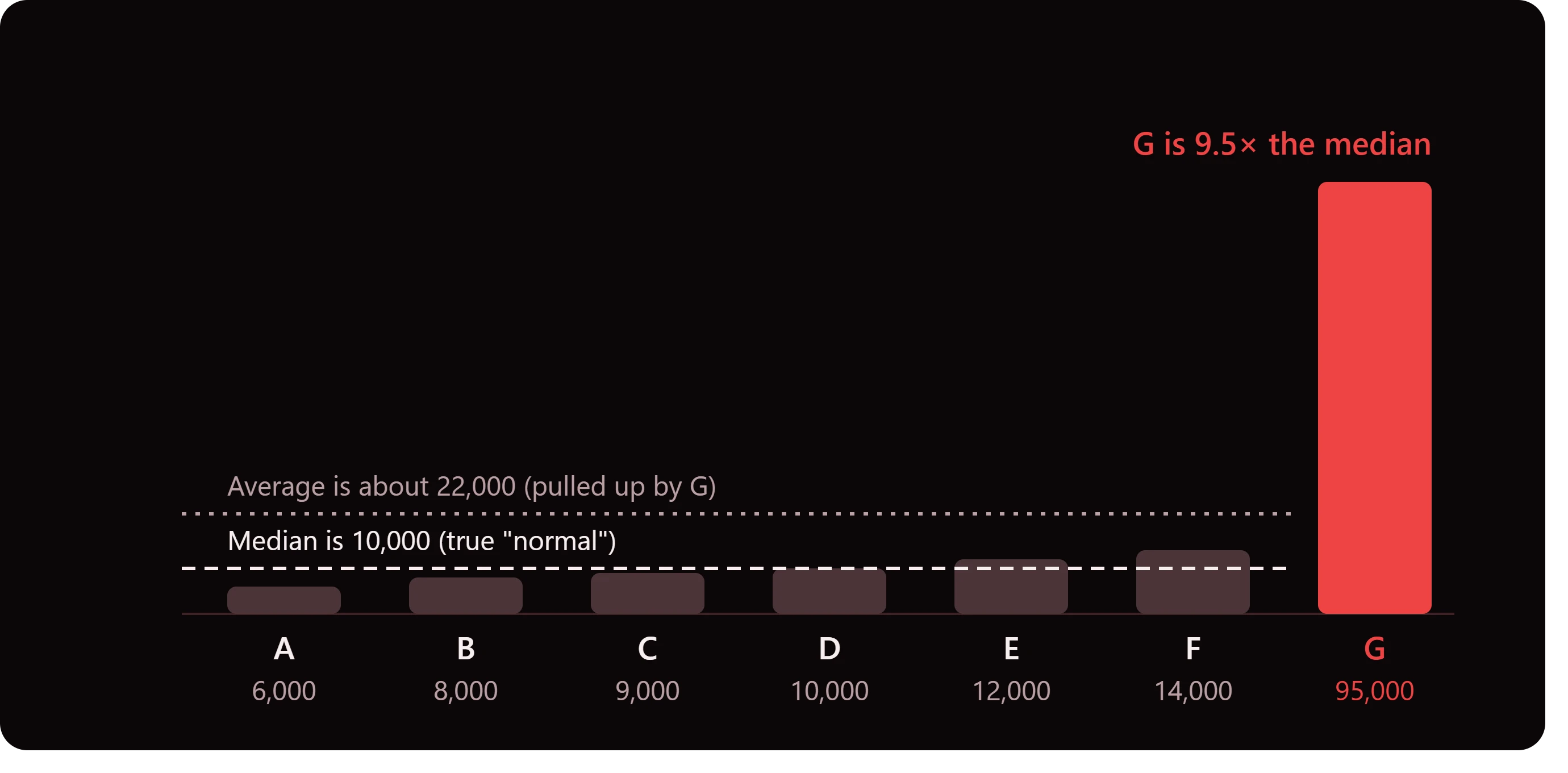
- Median: the 4th of 7 values, which is 10,000.
- Average: about 22,000, inflated by video G.
- Video G's ratio against the median: 95,000 ÷ 10,000 = 9.5×.
- Against the average, it would look like only about 4.3×, which hides how unusual it was.
- Video F: 14,000 ÷ 10,000 = 1.4×. A good video, but not an outlier worth studying.
Video G is the one to open and study: its title, thumbnail, topic, length, and hook.
Compare like with like: video age and format
A raw ratio can still mislead you. Check these two things first.
- Video age. A video published yesterday hasn't had time to collect views. A five-year-old video has had years. A fresh upload at 2× the median after two days may become a much bigger outlier, while an old video at 2× may just have had more time. YT Outlier also shows views per hour, which rewards videos gaining views quickly right now.
- Format (Shorts vs long-form). Shorts can collect view counts that long videos on the same channel never reach, and the earnings per view are far lower. Compare Shorts with Shorts and long videos with long videos. For Shorts research, use the Shorts Radar.
Avoid tiny baselines
Ratios get noisy when the numbers are small. If a channel's median is 150 views, a video with 1,500 views is a "10× outlier." But that's only 1,350 extra views, which could come from one share in a group chat.
Rules of thumb for beginners:
- Be skeptical of big ratios on channels with very low medians.
- Prefer outliers that are big in both senses: a high ratio and a meaningful number of views.
- Look for patterns. Two or three outliers on the same topic tell you far more than one spike.
Treat estimates as estimates
Many outlier tools, YT Outlier included, show estimated monthly views and estimated earnings. Read these as rough ranges, not facts.
YT Outlier reads public YouTube pages, the same counts anyone can see. YouTube rounds some public numbers, such as subscriber counts, so figures can lag or differ slightly from what a creator sees in YouTube Studio. Earnings are estimated by applying an RPM band (revenue per 1,000 views) to recent views, so they are approximate by design. YT Outlier is not affiliated with YouTube or Google and doesn't see anyone's private analytics. The FAQ explains exactly how the numbers are worked out.
How to check any outlier manually on YouTube
A tool shortlists. Your own eyes confirm. Before you build anything on an outlier, open it on YouTube and check:
- Is it comparable? Same format (Short vs long) and similar length to the channel's usual uploads.
- Was there an outside push? A collaboration, news event, trend, or famous guest can explain a spike you can't reproduce.
- Title and thumbnail. What promise does the packaging make? This is often the real reason for the spike.
- The first 30 seconds. How quickly does the video get to the point?
- Comments. What do viewers say they liked, or what do they ask for next?
- Is it repeatable? Look for other channels in the niche with outliers on the same idea.
Use outliers ethically: learn the pattern, don't copy the video
Outlier research is about understanding why something worked, not re-uploading someone else's work.
- Keep the insight, change the execution. If "why this empire collapsed" took off, the insight is the angle and the curiosity gap, not the script.
- Never reuse someone's footage, voice-over, script, or thumbnail.
- Add something: better research, a clearer explanation, a different sub-topic, or a fresh point of view.
- Credit sources you rely on for facts.
Our article on faceless YouTube channel truths for 2026 shows how to keep a format's structure while adding your own angle.
What you get with YT Outlier for free
YT Outlier is an online YouTube outlier tool. You paste a channel and it analyzes that channel's recent uploads. An account is required.
On the free plan you get:
- Scores for a channel: outlier multipliers, views per hour, and estimates
- The first few uploads, a couple of similar channels, and a few related keywords
- A limited number of channel, topic, and keyword searches per day
- The first few matching niches in the Niche Finder
Pro adds: full lists, the AI playbook, script outlines, and more. Prices are shown on the pricing page before you pay.
Free is genuinely useful for spotting outliers on a handful of channels a day. It is not unlimited.
The YouTube outlier extension
There is also a YouTube outlier extension for Chrome, Brave, and other Chromium browsers. It adds a quick stats strip to channel pages and outlier badges to thumbnails while you browse YouTube. Free accounts get badges on a limited set of videos.
It is not on the Chrome Web Store yet. For now you install it manually from a download link, and the steps are in the FAQ.
How to choose the best YouTube outlier tool
Instead of trusting any "best of" list (including this blog), test tools yourself:
- Does it say what the ratio is measured against: median, average, or something else?
- Does it separate Shorts from long-form videos?
- Does it show video age or a speed measure like views per hour?
- Does it label earnings and monthly views as estimates?
- Are the free limits clearly stated, rather than a vague "free trial"?
- Spot-check it. Pick a channel you know and confirm the flagged outlier really is far above that channel's usual views.
A note on "YouTube outliers Reddit" searches: Community threads can be useful, but check the date (tools change fast), look at the poster's history for repeated promotion of one product, and prefer posts that show how someone used a tool. We don't claim any particular Reddit thread recommends YT Outlier. Evaluate every recommendation, ours included, on evidence you can check.
A 5-step routine to start today
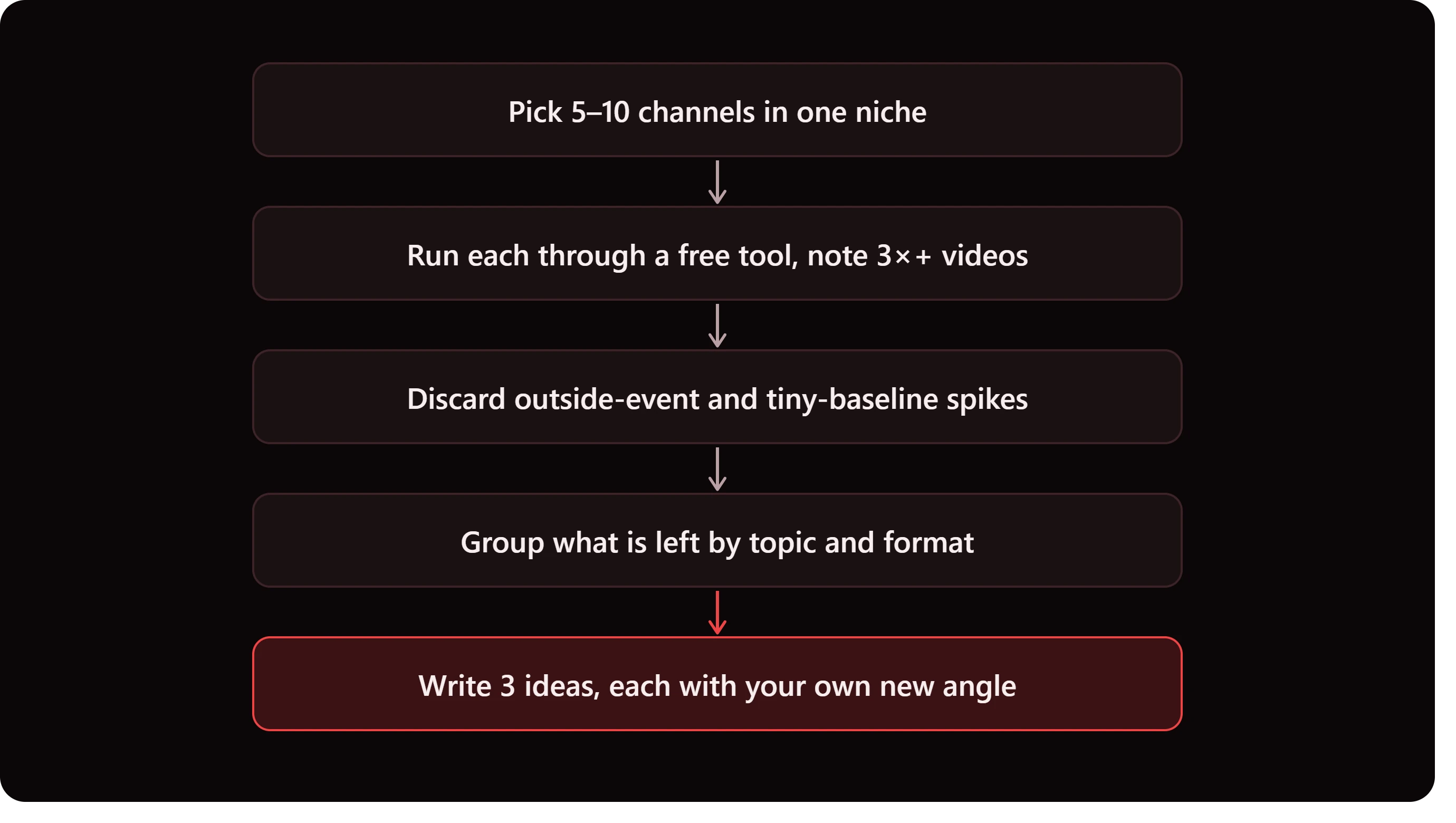
- Pick 5–10 channels in a niche you're considering.
- Run each through a free outlier tool. Note any video above about 3× the channel median with real view volume.
- Discard false signals: outliers explained by outside events, collaborations, or tiny baselines.
- Group what's left by topic and format. Patterns that repeat across channels are your best signals.
- Write three video ideas from those patterns, each with your own new angle.
Ready to try it? Get YT Outlier free, paste a channel you follow, and see which of its videos are true outliers.
Frequently asked questions
What is an outlier video on YouTube?
A video that gets far more views than its channel's typical video, usually measured as a multiple of the channel's median views.
What is a good outlier ratio?
There's no official number. A common starting point is about 3× the median with meaningful view volume. Higher ratios (5× to 10×) deserve a closer look, as long as the channel's baseline isn't tiny.
Is there a free YouTube outlier tool?
Yes. YT Outlier has a free plan with daily search limits and trimmed lists. Pro unlocks the full lists and extra features.
Why use the median instead of the average?
Because viral videos inflate the average. The median shows what is normal for the channel.
Can I use outlier videos to copy ideas?
Use them to understand the topic, angle, and packaging that worked. Don't copy footage, scripts, voice-overs, or thumbnails. Make something original.
Are the earnings numbers accurate?
No. They are estimates based on public view counts and an RPM band, not a creator's real payouts.
Is there a YouTube outlier extension?
Yes, for Chrome, Brave, and other Chromium browsers. It isn't on the Chrome Web Store yet, so it's installed manually (see the FAQ).