How to Find a YouTube Niche: A Beginner's Research Guide
Learn how to find a YouTube niche with a clear research process: demand, breakout channels, low-competition gaps, RPM checks, and a free niche research tool.
· 9 min read · YT Outlier
Quick answer: To find a YouTube niche, start with a few topics you can stick with, then validate them with real channel data. Look for demand (channels getting solid monthly views), freshness (newer channels growing too), a breakout ratio (views clearly beating subscriber size), and monetization fit (estimated RPM and earnings). A free YouTube niche finder like YT Outlier helps you filter those signals instead of guessing from a notebook.
In this guide:
- What a YouTube niche really is
- Why most niche lists fail beginners
- The 4 signals that matter
- How to use a niche research tool
- Finding profitable and lower-competition niches
- A 5-step research routine
- What free YT Outlier shows you
- FAQ
What is a YouTube niche (and what it is not)
A YouTube niche is the specific audience problem, curiosity, or entertainment need your channel repeatedly serves. "History" is a category. "Ancient Rome for busy people in under 12 minutes" is closer to a niche. "Personal finance" is a category. "Credit score tips for first-job renters in India" is closer to a niche.
A niche is not:
- A random keyword with search volume
- A trend that lasts two weeks
- A topic you hate but saw on a "top niches" list
The right niche is narrow enough that a viewer knows what they get, and broad enough that you can publish for months without repeating yourself.
If you are also deciding whether to show your face, read Faceless YouTube Channel Truths for 2026. Format choice and niche choice should be decided together.
Why most "best niches" lists fail beginners
Generic lists of profitable YouTube niches are usually too late, too broad, or too abstract. By the time a topic is on every list, the easy packaging angles are crowded. A better question is:
Which niches still show proof that newcomers can grow?
Proof looks like:
- Channels under a year old already getting meaningful monthly views
- Videos that outperform a channel's own baseline (outliers)
- Formats that can monetize through ads, affiliates, or digital products
That is niche research, not niche browsing.
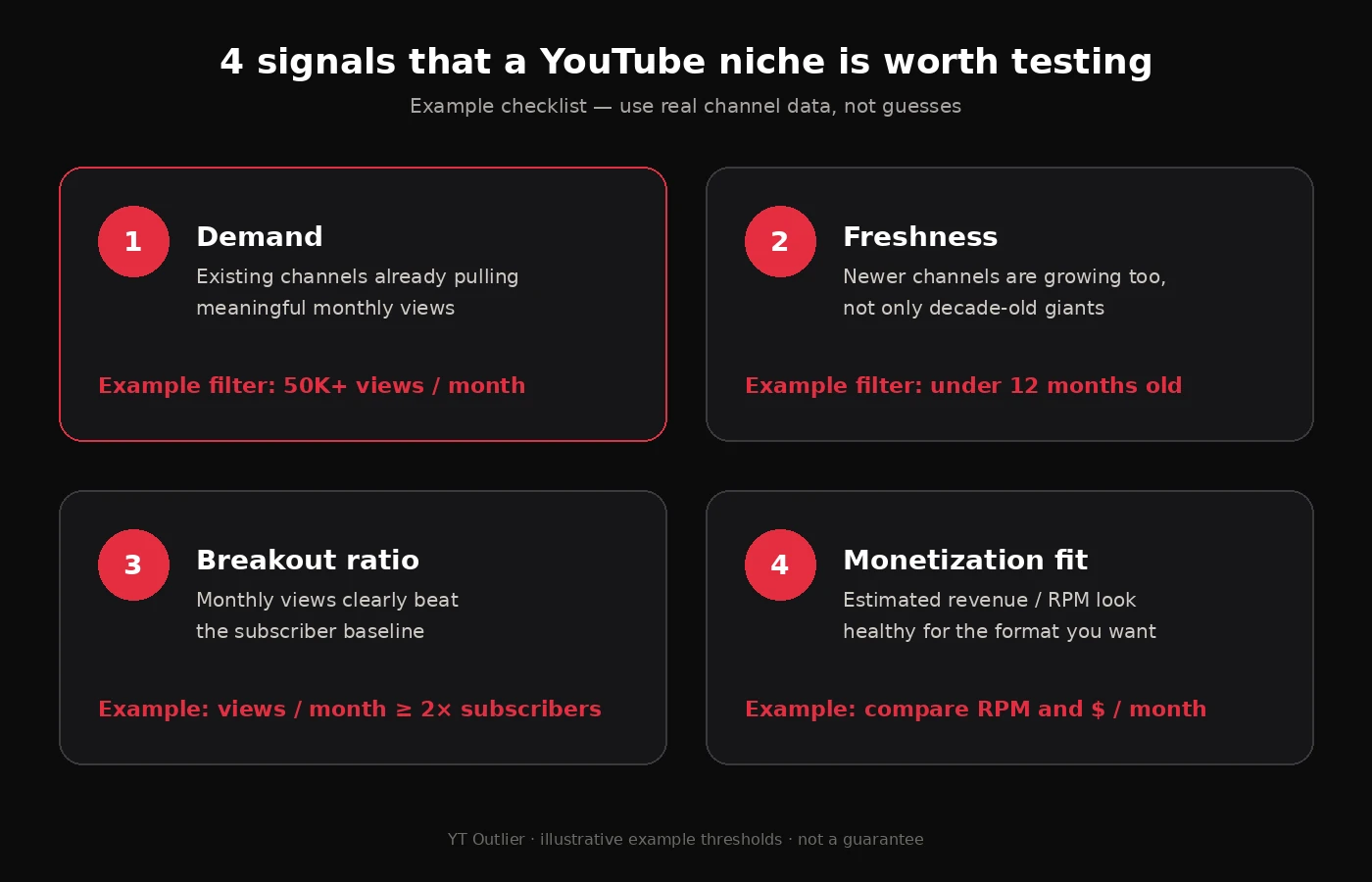
The 4 signals that a niche is worth testing
Use these as a checklist before you commit. The thresholds below are examples for research, not guarantees that a channel will succeed.
1. Demand
Someone is already watching. If every channel in the space is tiny and stuck, the topic may be interesting to you and invisible to the audience. In YT Outlier's Niche Finder, monthly views is one of the first filters to use.
2. Freshness
Older giants prove a topic can work. Newer growers prove it can still work for people starting now. YT Outlier's Breakout channels preset looks for channels under 12 months old with at least 50K monthly views and a monthly-views-to-subscribers ratio of 2× or higher.
3. Breakout ratio
A channel with 200,000 subscribers and 150,000 views a month is not the same story as a channel with 8,000 subscribers and 150,000 views a month. The second one is punching above its weight. That ratio is a practical way to spot low competition YouTube niches where packaging and topic still have room.
4. Monetization fit
Views are not income. Two niches with similar traffic can pay very differently because of RPM (revenue per 1,000 views), ad suitability, and format. YT Outlier shows estimated earnings using RPM bands; the FAQ explains how those estimates are calculated. Treat them as ranges for comparison, not invoices.
How to use a YouTube niche finder without getting lost
A niche research tool is only useful if you ask it specific questions. Open the Niche Finder and work in this order:
- Pick a preset or start blank. Use Breakout channels when you want proof that newcomers are growing. Use Market gap when you want faceless formats with estimated revenue of at least $5K a month, sorted by RPM.
- Add one constraint at a time. Country, Shorts vs long-form, faceless vs on-camera, subscriber range, monthly views, RPM, or estimated revenue.
- Sort for the decision you care about. Views, subscribers, estimated earnings, ratio, RPM, or newest.
- Save 8–12 channels, not 100. Your job is a shortlist, not a spreadsheet hobby.
- Click into a few channels and study their outlier uploads. The separate guide on the YouTube outlier tool free workflow covers that math.
If filters return nothing, loosen one filter at a time. Niche Finder can suggest which single filter is blocking the most results.
Finding profitable YouTube niches (without chasing hype)
"Profitable" usually means some mix of:
- Enough views to matter
- An RPM band that is not tiny for your format
- A path to mid-rolls, affiliates, or products that fits the content
A practical comparison method:
| What to compare | Why it matters | What to do |
|---|---|---|
| Monthly views | Demand | Filter a minimum, then sort |
| Estimated revenue | Business potential | Compare ranges across niches |
| RPM estimate | Pay quality of the traffic | Prefer niches where RPM is not rock-bottom for your format |
| Channel age | Room for newcomers | Prefer some young growers in the set |
| Outlier videos | Proven packaging | Study titles, thumbnails, hooks |
Hypothetical example for the method only: Niche A shows several young channels around 80K–120K monthly views with higher estimated RPM. Niche B shows older channels with bigger absolute views but weaker estimated earnings for similar traffic. Niche A may be the better beginner bet even if it looks "smaller" on paper.
Also check Shorts Radar if your niche may live as Shorts. Shorts and long-form are different products with different RPM bands, so do not mix their economics casually.
Finding lower-competition niches without inventing scarcity
"Low competition" does not mean empty. Empty usually means no demand. Lower competition usually means:
- Demand exists
- Packaging angles are not fully saturated
- Newer channels can still break out
Signals of room:
- Multiple breakout channels under 12 months old
- Outlier videos with clear, copyable structures (not one-off news spikes)
- Faceless or hybrid formats still earning in the Market gap preset
Signals of a trap:
- Only decade-old giants
- Every title is the same template
- Views exist but estimated earnings look weak for the work required
- The only "proof" is a viral video tied to a one-time event
A 5-step routine: how to find a YouTube niche this week
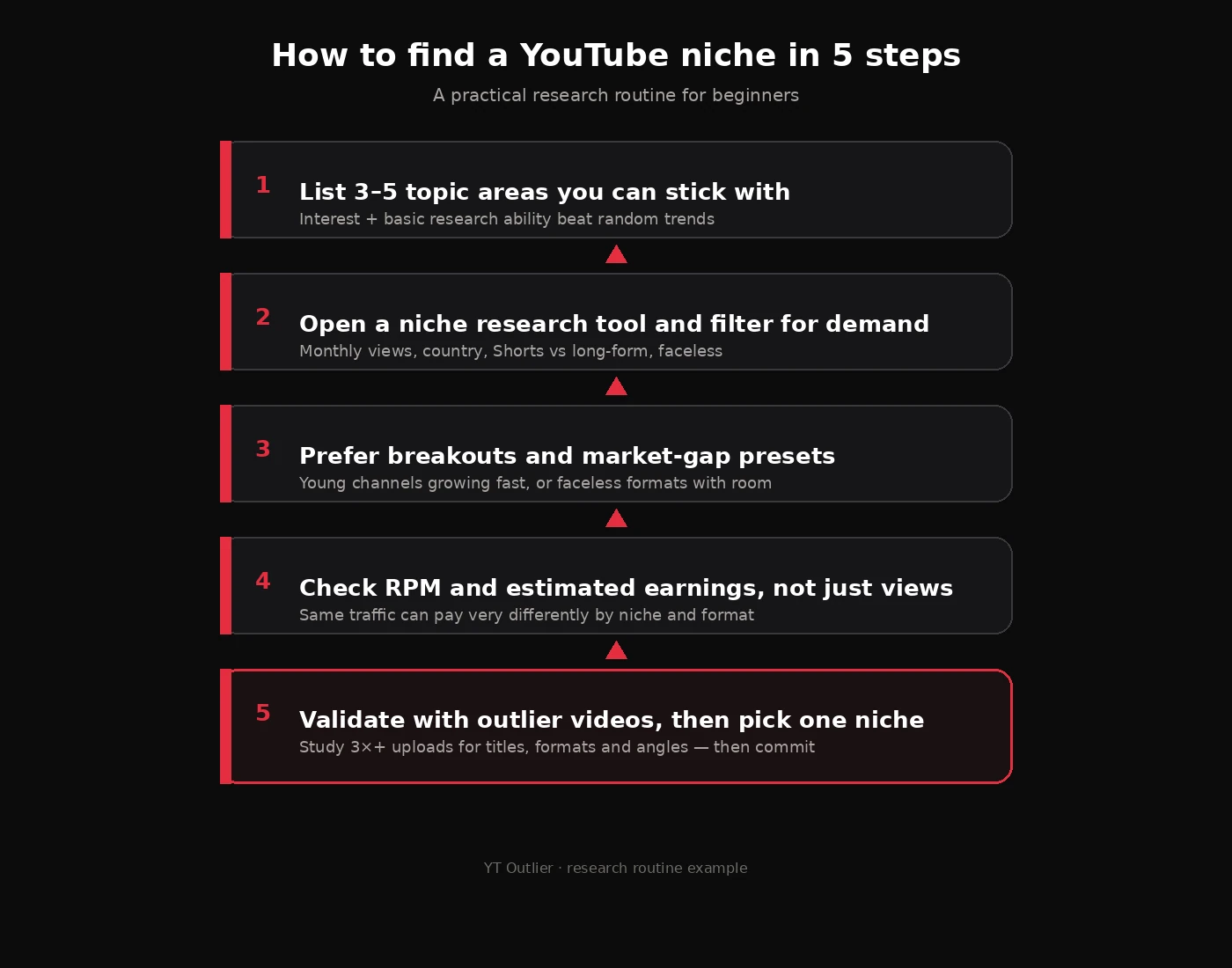
- List 3–5 topic areas you can stick with. Interest and research ability beat a random "hot" list.
- Open a niche research tool and filter for demand. Start with monthly views, then add country and format.
- Prefer breakouts and market-gap presets. You want evidence that growth is still happening.
- Check RPM and estimated earnings, not just views. Same traffic can pay very differently.
- Validate with outlier videos, then pick one niche. Study a handful of 3×+ uploads for titles, formats, and angles, then commit for a real test batch of videos.
Do not launch five channels at once. One niche, a small set of tested formats, and honest review after a few uploads will teach you more than endless shortlisting.
What you get free with YT Outlier for niche research
These limits come from the current product, not from marketing fluff:
- Niche Finder: free visitors see 3 full channel rows plus 6 locked placeholders. Paid plans unlock full paging with Show more.
- Breakout channels preset: under 12 months old, monthly views at least 2× subscribers, and 50K+ views a month.
- Market gap preset: faceless formats with estimated revenue of at least $5K a month, highest RPM first.
- Channel / topic / keyword searches: free accounts get 5 per UTC day.
- Channel reports: free shows scores such as outlier multipliers and estimates, with trimmed lists (first uploads, similar channels, related keywords).
- Pricing: Pro is $19 / month and Pro+ is $29 / month on the current plans. See pricing for details.
Create a free account at /login?mode=up if you want saved preferences and the free daily search allowance on your account.
YT Outlier is not affiliated with YouTube or Google. Earnings are estimates. Public counts can be rounded or delayed. Always use the numbers as research signals, then verify packaging by watching the actual videos.
Next steps
- Open the YouTube niche finder.
- Run Breakout or Market gap, then tighten one filter.
- Shortlist channels and study their outlier videos.
- Decide faceless vs on-camera with the 2026 faceless guide.
- Skim the FAQ, then sign up free if you want the account tools.
Frequently asked questions
How do I find a YouTube niche as a complete beginner?
Start with a few topics you can research consistently, then validate them with channel data: monthly views, channel age, breakout ratio, and estimated earnings. Use a niche research tool to shortlist channels, then study outlier videos for packaging ideas before you commit.
What is a YouTube niche finder?
A YouTube niche finder is a research page that filters real channels by niche, views, revenue estimates, RPM, age, country, and format. YT Outlier's Niche Finder includes Breakout and Market gap presets so you can spot growing or higher-RPM opportunities faster than manual scrolling.
What are profitable YouTube niches?
Profitable niches usually combine real demand with a workable monetization path. Compare estimated RPM and monthly earnings across similar channels instead of trusting a static "top niches" list. Profitability also depends on your format, upload consistency, and whether viewers can be monetized with ads or offers.
How do I find low competition YouTube niches?
Look for demand plus room: newer channels growing, outlier videos with clear formats, and packaging that is not fully saturated. Empty niches are often low demand, not low competition. Breakout filters are a practical way to find spaces where newcomers are still winning.
Is niche research enough before I start a channel?
No. Research helps you pick a better starting hypothesis. You still need to publish, measure retention and clicks, and adjust. Treat your first batch of videos as tests of titles, thumbnails, and formats inside the niche you chose.
What free niche research can I do on YT Outlier?
You can use Niche Finder with 3 open rows and 6 locked placeholders, run the Breakout and Market gap presets, and use free daily channel or topic searches on an account. Full unlimited paging and deeper Pro lists require a paid plan. Details are on pricing and in the FAQ.
Should I choose a faceless niche or show my face?
Either can work. Choose based on the formats already winning in the niche, your production strengths, and monetization fit. For a deeper look at faceless systems and RPM realities, read Faceless YouTube Channel Truths for 2026.