Profitable YouTube Niches in 2026: How to Find One That Actually Pays
What makes a YouTube niche profitable in 2026, which niche categories are worth researching, how RPM and views combine into revenue, and a five-check test to validate a niche with real channel data.
· 9 min read · YT Outlier
Quick answer: A profitable YouTube niche in 2026 is one where advertisers pay well per view (a higher RPM), viewers keep watching, newer channels are still growing, and you can make the videos consistently. No list of niches can promise money. The reliable approach is to shortlist a few categories, then check real channels in each one: monthly views, estimated earnings, effective RPM, channel age and format. A free niche finder does that filtering for you.
In this guide:
- What makes a niche profitable
- How niche profit actually works
- Niche categories worth researching in 2026
- The five-check profitability test
- How to check a niche with real data
- Faceless vs on-camera niches
- Common mistakes
- What YT Outlier shows for free
- FAQ
What makes a YouTube niche profitable in 2026?
Most "profitable YouTube niches" lists repeat finance, tech and make money online. They are not wrong, but they skip what decides whether you will earn anything:
- Advertiser value. Some audiences are worth more to advertisers than others. Viewers researching a credit card, a laptop or business software are closer to spending money than viewers watching a prank compilation, so ads on those videos usually pay more.
- Demand you can measure. Real channels in the niche are getting steady monthly views, not just one viral video.
- Room for newcomers. Channels started in the last year are still breaking through. If every successful channel is ten years old, the niche may be locked up.
- A format you can repeat. You need to publish dozens of videos. A niche you can research and produce every week beats a "high RPM" niche you abandon after five uploads.
Profit is the overlap of all four. Great ad rates with no room for new channels is a trap; so is fast growth on views that pay almost nothing.
How niche profit actually works
Ad revenue on YouTube comes down to a simple formula:
Estimated monthly ad revenue = monthly views × RPM ÷ 1,000
RPM (revenue per mille) is what a creator earns per 1,000 views after YouTube's share. YouTube's own rules matter here too. To earn ad revenue you need to join the YouTube Partner Program, which requires 1,000 subscribers plus either 4,000 valid public watch hours in the last 12 months or 10 million valid public Shorts views in the last 90 days. Under YouTube's published terms, creators keep 55% of net ad revenue from long-form videos and 45% of their allocated share from Shorts.
That is why the niche you pick changes your income even at the same view count:
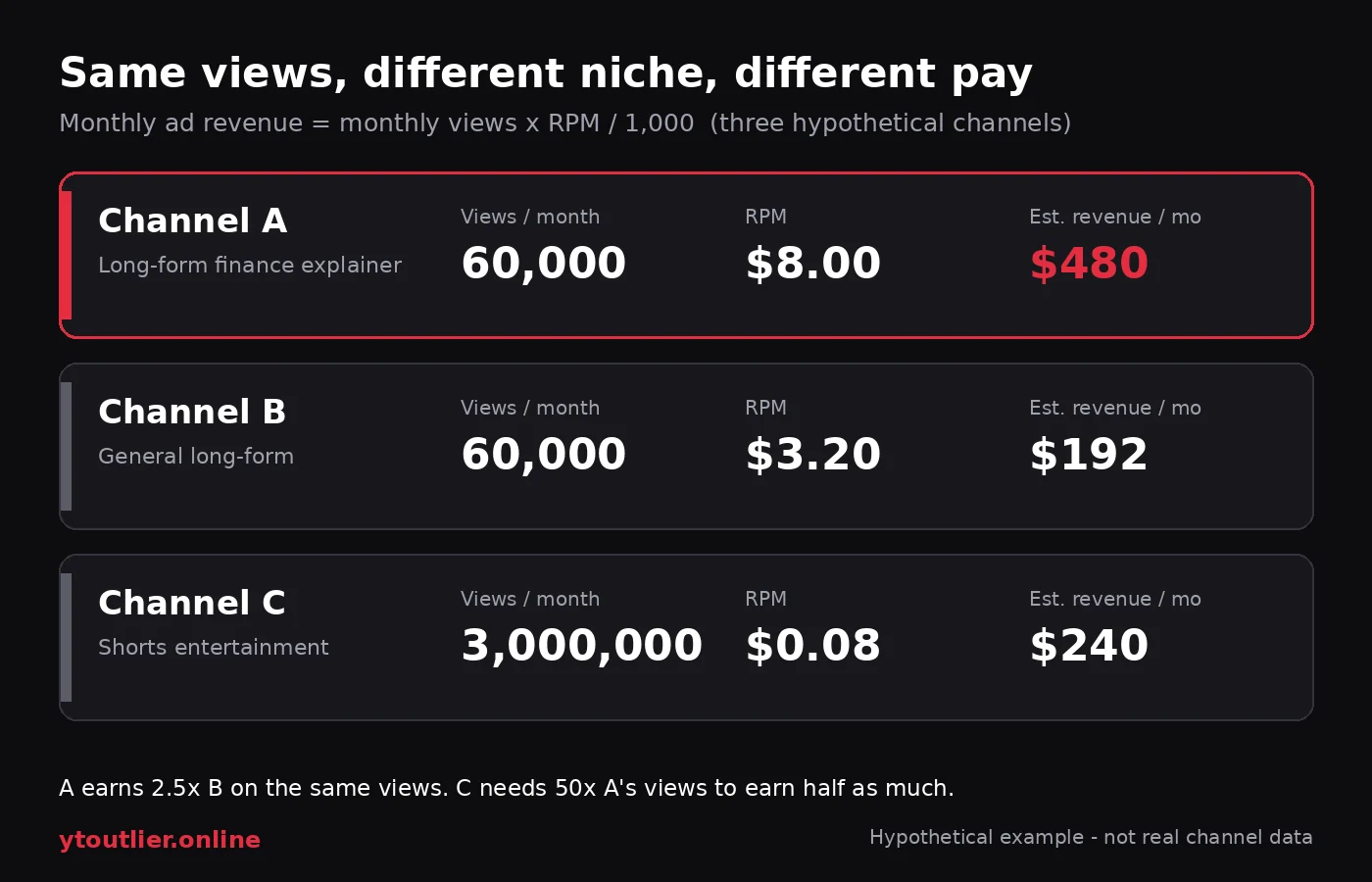
In this hypothetical example, Channel A and Channel B get the same 60,000 monthly views, but the higher-RPM niche earns 2.5 times more. Channel C needs 50 times the views of Channel A to earn about half as much, because Shorts usually pay far less per view.
For reference, YT Outlier's channel estimates use $2.50–$4.00 per 1,000 views for long-form (typical $3.20) and $0.04–$0.12 for Shorts, and its Monetization calculator uses niche-specific bands. Real RPM depends on the audience's country, the season, the Shorts mix and whether the channel is monetized at all, so treat every estimate as a ballpark, not a promise. The FAQ explains how the estimates are calculated.
Profitable YouTube niche categories to research in 2026
These are categories, not guarantees. Each one tends to attract advertisers or long viewing sessions, and each one has a catch. Use them as a shortlist to test with data.
- Personal finance and money basics. Budgeting, saving, credit, taxes for beginners. Advertisers in finance often pay more per view. The catch: it is competitive and accuracy matters, so you need real research and clear disclaimers.
- Business, software and AI tools. Tutorials for spreadsheets, design apps, website builders and AI tools. Viewers are often deciding what to buy, which advertisers value. The catch: tools change quickly, so videos go stale and need updating.
- Tech explainers and reviews. Phones, laptops, setups, "which one should I buy". Strong buyer intent and affiliate potential. The catch: big channels dominate launches, so newcomers win with angles like budget picks.
- Education and science explainers. How things work, space, engineering, psychology. Long watch times and evergreen search traffic. The catch: quality bar is high; thin scripts get ignored.
- History and documentary storytelling. Faceless narration over archive images, maps and animation. Long videos keep people watching, which suits ads. The catch: scripting and research take real time, and you must respect image and footage rights.
- Health, fitness and nutrition (carefully). Workouts, beginner routines, meal prep. Big audience and steady demand. The catch: health is a sensitive area, so avoid medical claims and cite proper sources.
- Home, DIY and practical how-to. Repairs, cleaning, organising, gardening. Evergreen search demand and product tie-ins. The catch: usually needs hands-on filming.
Notice what is missing: celebrity-style entertainment, reaction channels and personality vlogs. They can earn well, but they depend on one person, which makes them hard to copy or start from zero. For a beginner, a repeatable format inside a valuable category is the safer bet. If faceless is your plan, read what nobody tells you about faceless YouTube channels first.
The five-check profitability test
Before committing to a niche, run it through five checks. If it fails two or more, keep looking.
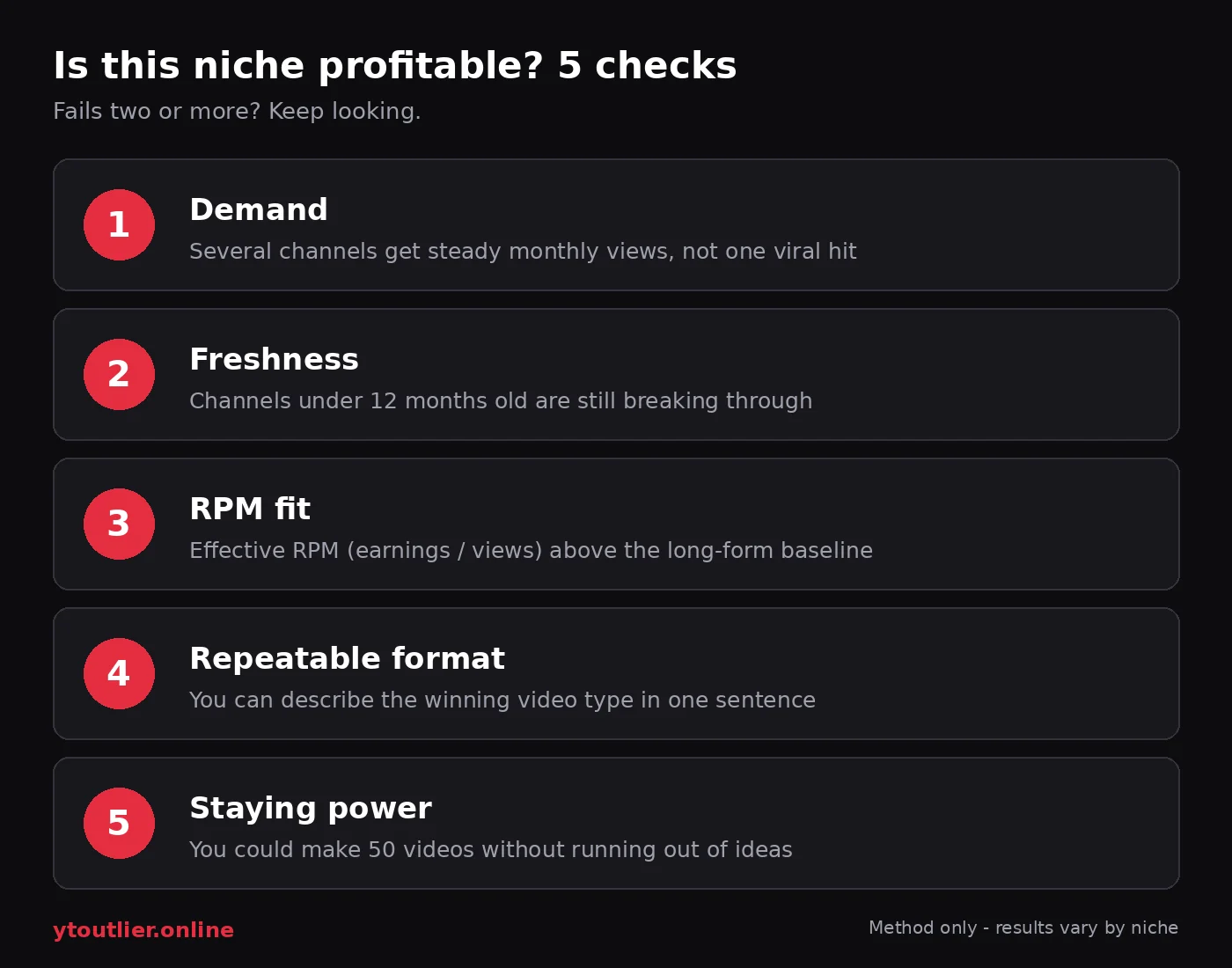
- Demand. Several channels in the niche get steady monthly views. One huge channel and nothing else is not proof of demand.
- Freshness. At least a few channels under 12 months old are growing. That shows new entrants can still break through. Our guide to YouTube breakout channels explains how to spot them.
- RPM fit. The niche's channels show an effective RPM (estimated earnings divided by monthly views) above the long-form baseline (YT Outlier's default long-form band is $2.50–$4.00).
- Repeatable format. You can describe the winning video type in one sentence, for example "10-minute explainers on one money mistake each".
- Staying power. You could make 50 videos on it without running out of ideas or interest. Write 20 titles today as a test.
How to check niche profitability with real data
Here is a practical routine using YT Outlier's Niche Finder:
- Start with the Market gap preset. It shows faceless-format channels estimated to earn at least $5K a month, sorted by RPM, highest first.
- Pick a niche and filter by RPM. Narrow to one niche, then set an RPM range. You will see whether high effective RPM shows up across many channels or just one.
- Switch to the Breakout channels preset. Breakouts are channels under 12 months old with at least 50K monthly views and monthly views at least 2× their subscribers. If a profitable niche also has breakouts, newcomers are still winning.
- Use the format filters. Filter by content type (Shorts, long-form or mixed), faceless or on-camera, country, channel age and an estimated "likely monetized" signal.
- Open the channels. Analyze a few channels and look at their outlier videos, the uploads that beat the channel's own median. Our guide on how to find outlier YouTube videos walks through this step.
- Check Shorts separately. If you are considering Shorts, use Shorts Radar to see which Shorts channels are growing, and remember the lower per-view pay.
If a filter combination returns nothing, the Niche Finder suggests which single filter to loosen. For the full niche-picking process, from interests to validation, see how to find a YouTube niche.
Faceless vs on-camera niches
Many of the most searched "profitable YouTube niches" lists are really lists of faceless niches: documentaries, explainers, finance breakdowns, top-10s. Faceless can work well, but two points matter in 2026:
- Originality is a monetization rule, not just a style choice. YouTube's monetization policies exclude mass-produced or repetitive content (which YouTube calls inauthentic content) and reused content without meaningful added value. Low-effort AI slideshows and reuploaded clips are exactly what those rules target.
- Your edge has to come from somewhere. Without a face, your edge is research, scripting, voice, visuals and pacing. Budget the time for that.
Neither faceless nor on-camera is automatically more profitable; check both with the data.
Common mistakes when choosing a profitable niche
- Picking by RPM alone. A high RPM on 2,000 views a month is still very little money. Demand matters as much as rate.
- Copying one viral channel. Learn the pattern across several channels, then make original videos.
- Quitting too early. Monetization requirements take time to reach. Pick something you can sustain for a year.
What YT Outlier shows for free
These details come from the current product and FAQ:
- An account is required. Free accounts see the scores (outlier multipliers, views per hour and earnings estimates) with trimmed lists: the first 3 uploads, 2 similar channels and 3 related keywords, plus 5 channel, topic or keyword searches per UTC day.
- Niche Finder: free visitors see 3 full channel rows, then locked placeholders. The Market gap and Breakout channels presets are on the page.
- Shorts Radar: free visitors see the first 3 rows.
- Pro and Pro+ unlock the full lists and the AI tools. Every paid plan starts with a 3-day free trial (card required), then $19/mo for Pro or $29/mo for Pro+, cancel anytime (USD prices; see pricing for your currency).
Data comes from public YouTube pages, which YouTube rounds and can delay, and earnings are estimates. YT Outlier is not affiliated with YouTube or Google.
Create a free account to start checking which niches actually pay.
Frequently asked questions
What are the most profitable YouTube niches in 2026?
Categories with valuable audiences tend to pay more per view: personal finance, business and software tutorials, tech reviews, education and documentary-style explainers. No niche guarantees income, so check real channels in each one for demand, estimated earnings and newer channels that are growing.
What is a high RPM YouTube niche?
It is a niche where creators earn more per 1,000 views, usually because advertisers value the audience. YT Outlier's default long-form estimate is $2.50–$4.00 per 1,000 views, so channels whose effective RPM sits well above that band are in a higher-paying niche, though real RPM also depends on country and season.
Are Shorts niches profitable?
They can be, but Shorts usually earn far less per view than long-form videos. YT Outlier estimates Shorts at $0.04–$0.12 per 1,000 views, so a Shorts channel needs much higher view counts to match a long-form channel's ad revenue.
How do I know if a niche is too saturated?
Look at channel age. If channels under 12 months old are still getting strong monthly views relative to their subscribers, the niche has room. If every successful channel is many years old and new ones stall, it is harder to break in.
Can a faceless channel be profitable?
Yes, if the videos are original and add real value. YouTube's monetization policies exclude mass-produced, repetitive and reused content, so faceless channels need strong research, scripting and editing rather than templates.
Can I research profitable niches for free?
Yes. A free YT Outlier account shows 3 full Niche Finder rows (with the Market gap and Breakout presets), the first 3 Shorts Radar rows, and 5 searches per UTC day. Paid plans start with a 3-day free trial; see pricing.