YouTube Breakout Channels: How to Find Fast-Growing Channels to Learn From
What YouTube breakout channels are, how to spot them with the views-to-subscribers ratio, how to tell a real breakout from a lucky spike, and how to turn them into ideas for your own channel.
· 9 min read · YT Outlier
Quick answer: YouTube breakout channels are young channels getting far more views than their subscriber count suggests. To find them, compare a channel's monthly views with its subscribers: when a month of views is at least double the subscriber count, on a channel under a year old, something is clearly working. Study what those channels repeat, not just their single biggest video, and use the pattern for your own original ideas.
In this guide:
- What a breakout channel is (and is not)
- The views-to-subscribers ratio, explained
- Where to find breakout channels
- Real breakout or lucky spike?
- What to study on a breakout channel
- YouTube Shorts breakout channels
- A weekly breakout routine
- What YT Outlier shows for free
- FAQ
What is a YouTube breakout channel?
Most "top channel" lists are full of giants that started years ago. They are interesting, but they tell a beginner very little. A channel with 20 million subscribers wins partly because it already has 20 million subscribers.
A breakout channel is the opposite: a newer channel that is growing faster than its size explains. It has not had years to build an audience, so its views are coming from the videos themselves, from topic choice, titles, thumbnails, hooks and format.
That is why fast growing YouTube channels are such useful research targets. They show:
- What works right now, not what worked in 2019.
- What works without a big audience, because they do not have one yet.
- Formats you can realistically make, especially when the channel is faceless or format-driven rather than built around one famous person.
The last point matters. A celebrity or personality channel can grow fast because of who is on camera, and you cannot copy a person. A breakout story, history or documentary channel usually grows because of a repeatable format, and a format is something you can learn from.
The views-to-subscribers ratio, explained
The simplest breakout signal is the views to subscribers ratio: monthly views divided by subscribers.
- A mature channel often gets fewer monthly views than it has subscribers, because many subscribers stopped watching long ago.
- A breakout channel often gets several times its subscriber count in views each month, because its videos are being recommended to people who have not subscribed yet.
Here is a hypothetical comparison. These three channels and their numbers are made up to show the math; they are not real channels.
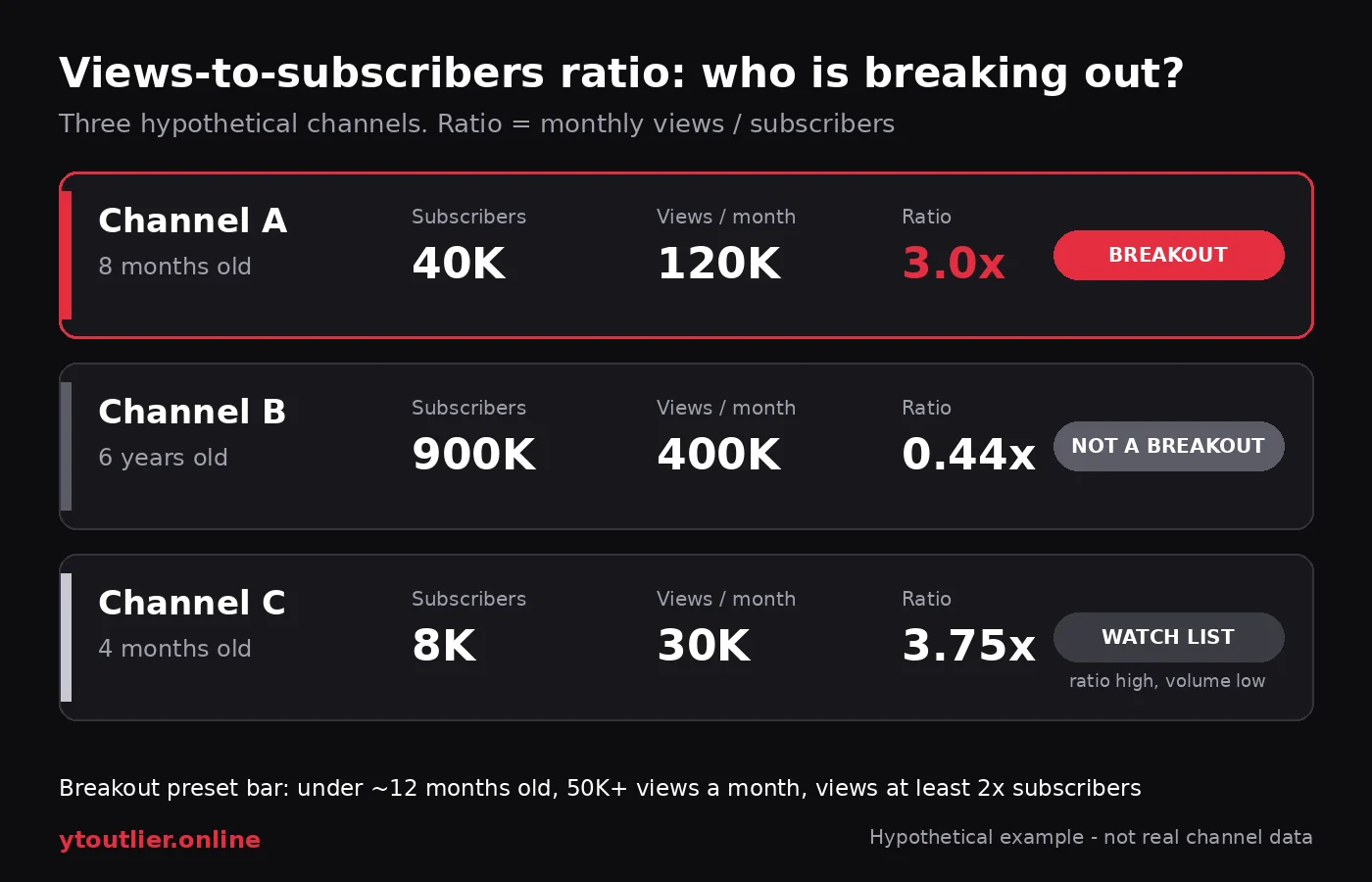
- Channel A (8 months old, 40K subscribers, 120K views a month): ratio 3.0×. Young, a strong ratio and real volume. That is a breakout.
- Channel B (6 years old, 900K subscribers, 400K views a month): ratio 0.44×. Big, but its views no longer keep up with its size. Not a breakout.
- Channel C (4 months old, 8K subscribers, 30K views a month): ratio 3.75×, but only 30K views. Promising, yet the volume is still small. Put it on a watch list.
This is exactly why the ratio alone is not enough. You want age, ratio and volume together.
Where to find YouTube breakout channels
You can calculate the ratio by hand from public channel pages, but it is slow. YT Outlier has three places built around this idea:
- Niche Finder Breakout channels preset: shows channels under about 12 months old with at least 50K views a month and monthly views at least 2× their subscribers. You can combine it with filters such as niche, country, Shorts vs long-form, faceless vs on-camera, and sort by the views-to-subscribers ratio or by newest.
- Shorts Radar: ranks Shorts-first channels by breakout, which is Shorts views in the last 30 days divided by subscribers. Channels at 1× or more get a Breakout tag, and each row shows the channel's top Short.
- Homepage "Channels breaking out right now": a rotating selection picked from real channel data the site gathers daily. It looks for young channels with strong recent views per subscriber, a recent upload doing at least 5× the channel's median, and regular uploads, and it filters out celebrity and personal-brand channels so the picks stay copyable as formats.
If you do not have a niche yet, start with how to find a YouTube niche, then filter the Niche Finder to that niche. A short list of 5 to 10 new YouTube channels growing fast in one niche is far more useful than 100 random ones.
Real breakout or lucky spike? Five checks
A good ratio is a starting point, not proof. Before you build plans around a channel, run these checks.
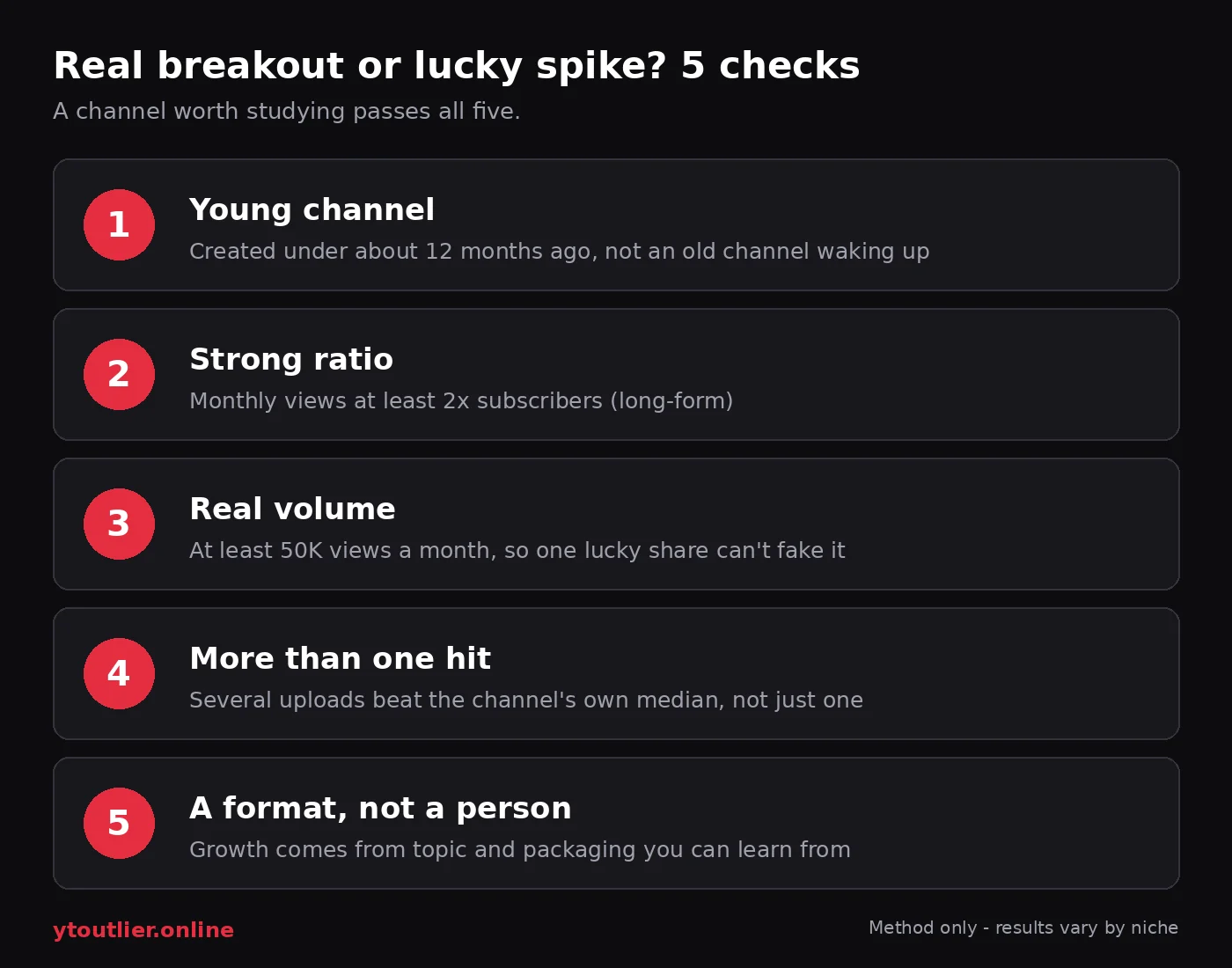
- Is it actually young? Check the channel creation date. An old channel that suddenly spikes may be a rebrand or an old audience waking up, which tells you less.
- Is the ratio strong? Monthly views at least 2× subscribers is a sensible bar for long-form channels.
- Is there real volume? A 5× ratio on a few thousand views can be one lucky share. A volume floor (the Niche Finder preset uses 50K a month) filters that out.
- Is it more than one video? Open the channel's uploads. If one video has all the views and everything else is flat, it is a single outlier, not a breakout channel. You want several uploads above the channel's own median.
- Is it a format or a person? If the growth depends on one creator's personality or fame, you cannot reproduce it. If it depends on a topic, structure and packaging, you can learn from it.
Channels that pass all five are worth real study time.
What to study on a breakout channel
Once a channel passes the checks, your job is to find out why it is growing. This is also the core of how to analyze a YouTube competitor.
| What to look at | Questions to ask |
|---|---|
| Outlier uploads | Which videos beat the channel's own median, and by how much? |
| Topics | Do the winners share a sub-topic, era, person, place or problem? |
| Titles | Is there a repeated title shape, such as a question, a number or a contrast? |
| Thumbnails | Same layout, colour, text style or face vs no face? |
| Length and pace | Are the winners shorter or longer than the channel's normal uploads? |
| Upload rhythm | How often do they post, and did growth start after a change? |
The fastest way to see the outlier uploads is to score each video against the channel's median views. A video at 2× the median is an outlier. The step-by-step method is in how to find outlier YouTube videos, and the math behind the score is in the YouTube outlier tool free guide.
Hypothetical example: a breakout history channel has six outliers, and four of them tell the story of one forgotten disaster in about ten minutes with a question title. Its broad overview videos sit near 1×. The lesson is the format ("one forgotten event, question title, tight runtime"), not any single video. You would test that format with your own topics and research.
Do not copy titles, scripts or thumbnails. Learn the pattern, then make something original.
YouTube Shorts breakout channels
YouTube Shorts breakout channels behave differently from long-form ones, so judge them separately:
- Shorts views pile up fast, so ratios can look huge. Compare Shorts channels with other Shorts channels, not with long-form.
- Look at how many Shorts the channel posted in the last 30 days and the average views per Short. A high total from 90 uploads is a different story from the same total from 10.
- Check the top Short. If it carries most of the views, study what made it work, then check whether the next few Shorts follow the same idea.
- Remember that Shorts earn far less per view than long-form. Shorts Radar shows earnings estimates using a much lower Shorts RPM, and they are estimates, not payouts.
If you are still choosing between formats, Faceless YouTube Channel Truths for 2026 covers the trade-offs honestly.
A weekly breakout channel routine
- Pick one niche. Use the niche guide if you are unsure.
- Shortlist 5 to 10 channels. Use the Breakout channels preset in the Niche Finder, or sort Shorts Radar by breakout for Shorts.
- Run the five checks. Drop one-hit wonders and personality channels.
- Open each channel's outliers. Note what the 2×+ videos have in common.
- Write the pattern in one sentence and brainstorm 3 to 5 original ideas that fit it.
- Test a small batch on your own channel and compare results with your own median.
Repeat weekly. Breakouts change fast, and the newest ones often show where a niche is heading.
What YT Outlier shows for free
These details come from the current product and FAQ:
- An account is required. Free accounts see the scores (outlier multipliers, views per hour and earnings estimates) with trimmed lists: the first 4 uploads, 2 similar channels and 3 related keywords. Free accounts get 5 channel, topic or keyword searches per UTC day.
- Niche Finder: free visitors see 3 full channel rows, then locked placeholders. The Breakout channels and Market gap presets are on the page.
- Shorts Radar: free visitors see the first 3 rows, and the breakout sort is available.
- Pro and Pro+ unlock the full lists and the AI tools. Every paid plan starts with a 3-day free trial (card required), then $19/mo for Pro or $29/mo for Pro+, cancel anytime (USD prices; see pricing for your currency).
Data comes from public YouTube data, which can be rounded or delayed, and earnings are estimates. YT Outlier is not affiliated with YouTube or Google.
Create a free account to start finding breakout channels in your niche.
Frequently asked questions
What are YouTube breakout channels?
Breakout channels are young channels getting far more views than their subscriber count suggests. YT Outlier's Breakout channels preset looks for channels under about 12 months old with at least 50K monthly views and monthly views at least 2× their subscribers.
How do I find fast-growing YouTube channels?
Compare monthly views with subscribers and check the channel's age. Young channels whose monthly views are at least double their subscribers, with real volume, are growing fast. The Niche Finder's Breakout channels preset and Shorts Radar's breakout sort do this filtering for you.
What is a good views-to-subscribers ratio?
There is no official YouTube benchmark. As a research rule of thumb, monthly views at least 2× subscribers on a young long-form channel is a strong signal, which is the bar YT Outlier's Breakout preset uses. Shorts channels often show higher ratios, so compare them only with other Shorts channels.
Is one viral video enough to call a channel a breakout?
No. One viral video is an outlier. A breakout channel has several uploads beating its own median and enough monthly volume to rule out luck. Check the uploads list before trusting the ratio.
Can I copy a breakout channel?
Learn from the pattern, not the content. Study the topics, title shapes, thumbnails and pacing that repeat across its outliers, then make original videos with your own research. Copying titles, scripts or thumbnails is unoriginal and can create copyright problems.
Can I find breakout channels for free?
Yes. With a free YT Outlier account, the Niche Finder shows 3 full rows (including the Breakout preset), Shorts Radar shows the first 3 rows, and you get 5 searches per UTC day. Paid plans start with a 3-day free trial; see pricing.