Low Competition YouTube Niches: How to Find Room to Grow in 2026
What low competition really means on YouTube, the signals that show a niche still has room for new channels, sub-niche angles worth testing, and a step-by-step way to check competition with real channel data.
· 9 min read · YT Outlier
Quick answer: A low competition YouTube niche is not one with no channels. It is one where viewers are clearly watching, but the channels serving them are few, young or not very good, so a new channel can still break through. The fastest way to spot one is to look for channels under 12 months old that already get strong monthly views compared with their subscriber count. A free niche finder lets you filter for exactly that.
In this guide:
- What low competition actually means
- Signs a niche still has room
- Low competition niche angles worth testing
- How to check YouTube niche competition with real data
- Low competition vs low demand
- Can a niche be low competition and high RPM?
- Common mistakes
- What YT Outlier shows for free
- FAQ
What "low competition" actually means on YouTube
Most lists of low competition YouTube niches are just unusual topics. But a topic with almost no channels often has almost no viewers either. That is low demand, not low competition.
A more useful definition has three parts:
- People are watching. Several channels in the niche get steady monthly views, so there is real demand.
- The field is thin or young. There are not dozens of large, polished channels covering every angle, or the successful ones are recent.
- Newcomers are winning. Channels started in the last year are still growing fast. This is the strongest sign, because it shows YouTube is willing to recommend new channels in that niche today.
Ten mediocre channels on a topic can be easier to beat than one excellent one. Your job is to find places where demand is ahead of supply.
Signs a niche still has room for new channels
Before you commit to anything, compare what an open niche looks like with a crowded one.
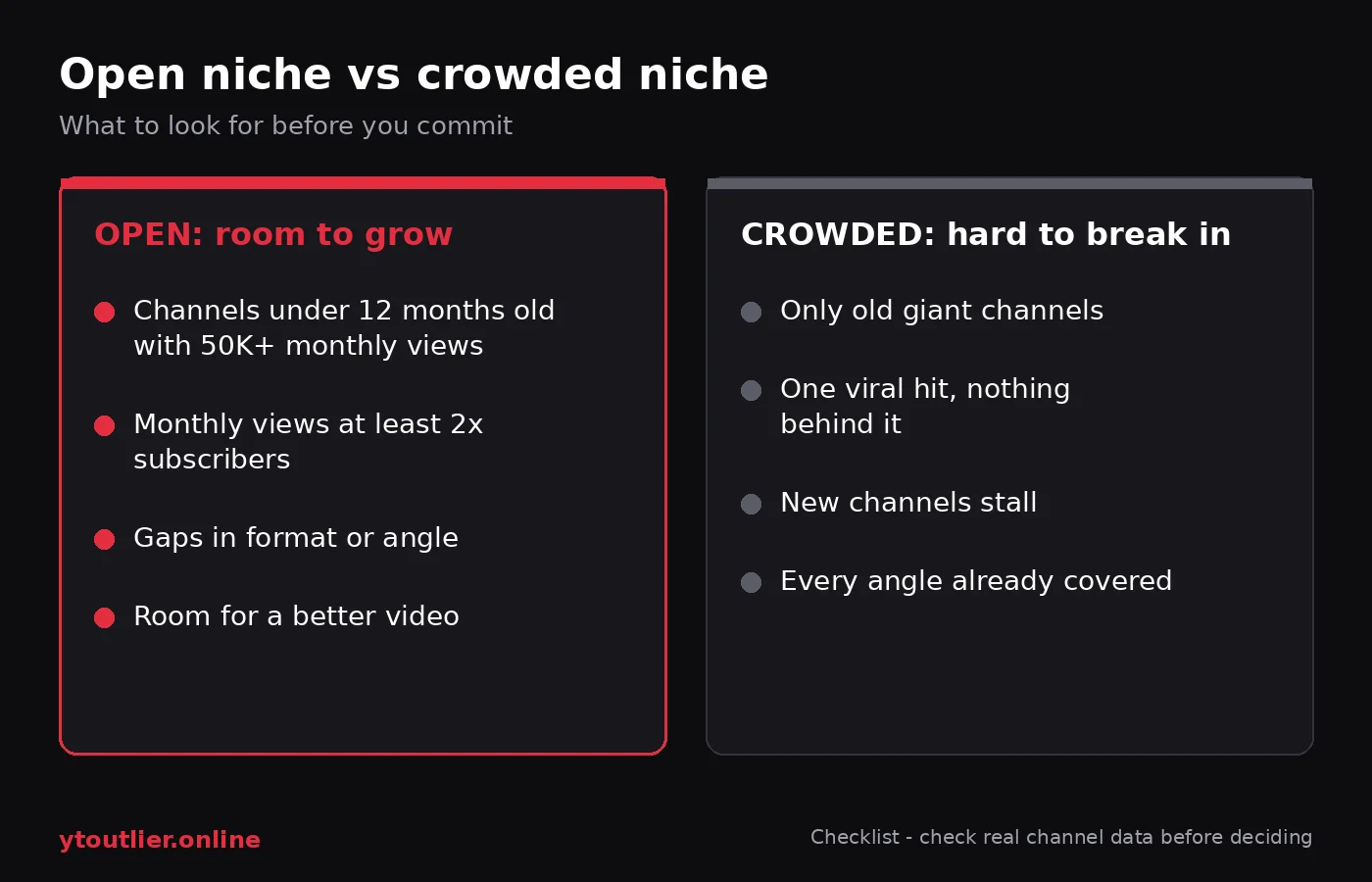
Signals that a niche is still open:
- Young channels with real views. Several channels under 12 months old get 50K or more views a month. If YouTube keeps recommending newcomers, you can be one of them.
- Views ahead of subscribers. A channel whose monthly views are at least twice its subscriber count is reaching people beyond its own audience. That usually means recommendations, not just loyal subscribers, are driving growth.
- Outlier videos on small channels. Videos that beat their channel's typical views by 2× or more show the topic pulls viewers on its own. See how to find outlier YouTube videos.
- Gaps in format or angle. Everyone makes 20-minute deep dives and nobody makes short explainers, or every channel targets experts and nobody serves beginners.
Signals that a niche is crowded: every successful channel is years old and new ones stall, one viral channel has nothing behind it, or every obvious title is already taken by large channels.
Low competition YouTube niche angles worth testing
There is no permanent list of untapped YouTube niches; any open niche can fill up once creators notice it. What lasts is the method for narrowing a broad niche. Angles to test (examples are hypothetical):
- Narrow by audience. Instead of "personal finance", try finance for a specific group, such as first-job earners or freelancers (hypothetical example). Big channels speak to everyone; a narrow audience often feels underserved.
- Narrow by problem. Instead of "home improvement", one specific job done well, such as fixing common problems in rented apartments without tools (hypothetical example).
- Narrow by format. Take a crowded topic and change the format: calm narrated documentaries instead of loud reaction videos, or long-form explainers on a topic that mostly lives in Shorts.
- Narrow by language or region. A topic that is crowded in English may have few quality channels in another language. If you can make videos in that language, check it separately.
- Combine two interests. History plus engineering, or psychology plus sport. Overlaps between two established niches often have viewers from both and few dedicated channels.
- Serve a new tool, game or trend early. New software and hobbies create demand before channels catch up, but they can fade.
If faceless documentaries or stories are your plan, read what nobody tells you about faceless YouTube channels first.
How to check YouTube niche competition with real data
Guessing is where most people go wrong. Here is a routine using YT Outlier's Niche Finder, which lists channels from a live pool with their subscribers, monthly views, estimated earnings, age, country and format:
- Start with the Breakout channels preset. It shows channels under 12 months old with monthly views at least 2× their subscribers and 50K+ views a month, sorted by views ÷ subscribers. Note which niches keep appearing. Our guide to YouTube breakout channels goes deeper.
- Pick one niche and set a channel age filter. Filter by channel age (1 week, 1 month, 3 months, 6 months or 1 year) and sort by newest channels. Count how many young channels are getting meaningful views.
- Compare young and old channels. Remove the age filter and sort by monthly views. If the top of the list is all old giants and the young channels are far behind, competition is high. If young channels sit close to the top, there is room.
- Check format and country. Filter by content type (Shorts, long-form or mixed), faceless or on-camera, and country. A niche can be crowded in one format and open in another.
- Look at similar channels. Open a promising channel's similar channels (same niche, roughly 1/3× to 3× its subscribers). This shows whether you are looking at one lucky channel or a group of peers growing together.
- Open the channels and find their outliers. Analyze a few channels to see which videos beat the channel's own median. Those topics show what viewers want and where you could make a better version.
- Check Shorts separately. If you plan Shorts, use Shorts Radar to see which Shorts channels are growing now.
If a filter combination returns nothing, the Niche Finder suggests which single filter to loosen. Here is how the results can look for two niches side by side:
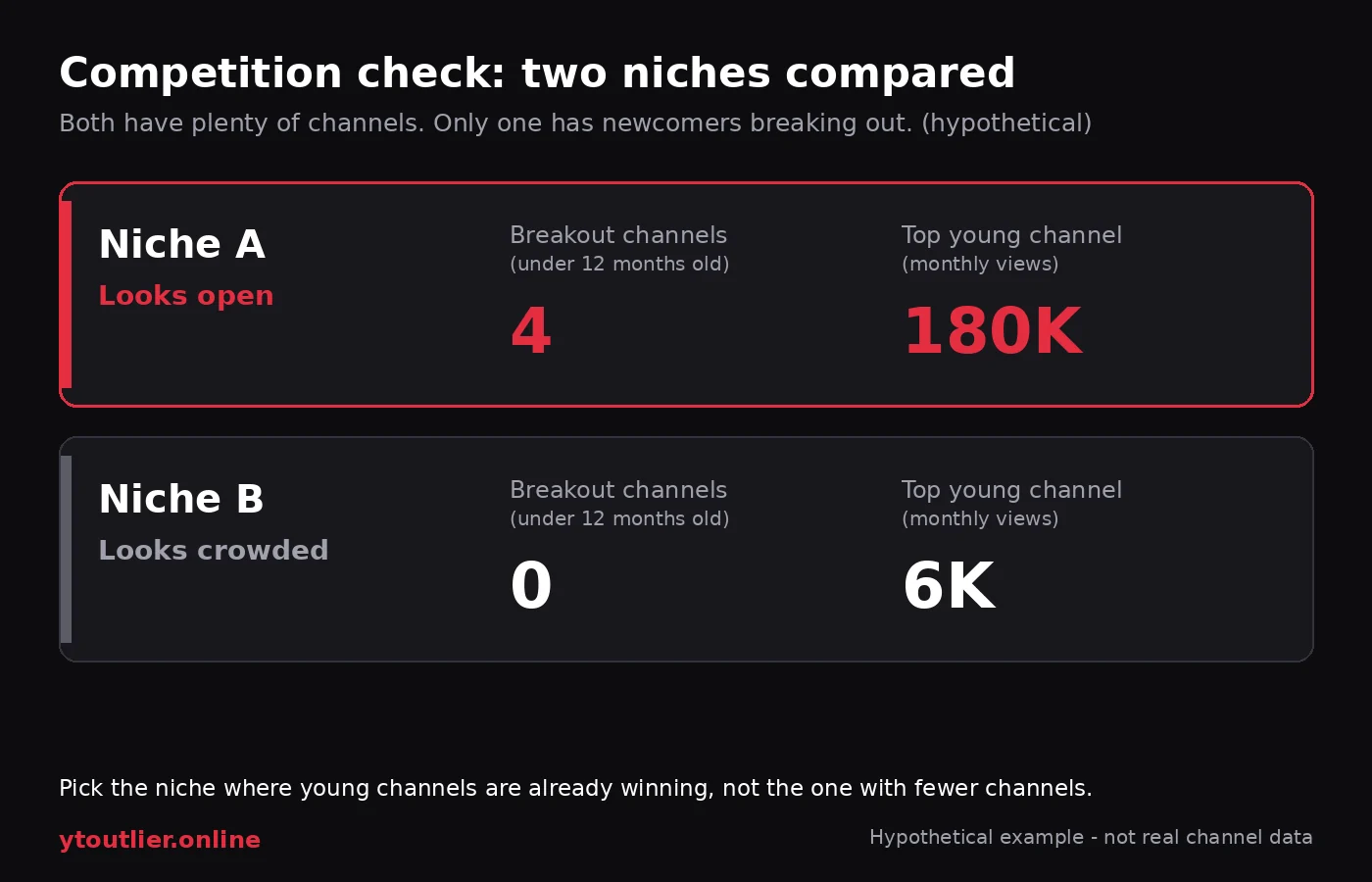
In this hypothetical example, both niches have plenty of channels, but Niche A has four young channels breaking out while newcomers in Niche B are stuck. Niche A is the better bet even if Niche B is "bigger".
Low competition vs low demand
The most common trap is mistaking an empty niche for an opportunity. Before you celebrate finding a niche with few channels, check:
- Do any channels get steady views? If the best channel gets a few thousand views a month after years of uploads, viewers may not be looking.
- Is the demand one video deep? One viral video does not prove people want 50 more.
- Can you reach monetization? To earn ad revenue you need to join the YouTube Partner Program, which requires 1,000 subscribers plus either 4,000 valid public watch hours in the last 12 months or 10 million valid public Shorts views in the last 90 days. A niche needs enough viewers to get you there.
A good low competition niche sits in the middle: smaller than the giant categories, but with proven, growing viewership.
Can a niche be low competition and high RPM?
Sometimes, but rarely for long. Niches where advertisers pay more per view, such as finance and software, attract more creators for that reason. The realistic route is a narrow angle inside a valuable category.
You can check this with data. Estimated monthly ad revenue is monthly views × RPM ÷ 1,000, where RPM is what a creator earns per 1,000 views after YouTube's share. YT Outlier's channel estimates use $2.50–$4.00 per 1,000 views for long-form (typical $3.20) and $0.04–$0.12 for Shorts. In the Niche Finder, set an RPM range and combine it with a channel age filter to see whether young channels in higher-paying niches are getting views. Treat every estimate as a ballpark: real RPM depends on the audience's country, the season, the Shorts mix and whether a channel is monetized. Our guide to profitable YouTube niches in 2026 covers RPM in more detail, and the FAQ explains how estimates are calculated.
Common mistakes when looking for low competition niches
- Trusting a list. Any published list of "untapped" niches is read by many other creators. Use lists as ideas, then check the data yourself.
- Choosing a niche you cannot sustain. A niche with less competition is useless if you run out of ideas after ten videos. Write 20 video titles before you commit.
- Copying one small channel. Learn the pattern across several growing channels, then make original videos. YouTube's monetization policies exclude mass-produced, repetitive and reused content without meaningful added value.
- Checking once. Competition changes. Re-check your niche every few months.
For the full process from interests to a validated niche, see how to find a YouTube niche.
What YT Outlier shows for free
These details come from the current product and FAQ:
- An account is required. Free accounts see the scores (outlier multipliers, views per hour and earnings estimates) with trimmed lists: the first 3 uploads, 2 similar channels and 3 related keywords, plus 5 channel, topic or keyword searches per UTC day.
- Niche Finder: free visitors see 3 full channel rows, then locked placeholders. The Breakout channels and Market gap presets are on the page.
- Shorts Radar: free visitors see the first 3 rows.
- Pro and Pro+ unlock the full lists and the AI tools. Every paid plan starts with a 3-day free trial (card required), then $19/mo for Pro or $29/mo for Pro+, cancel anytime (USD prices; see pricing for your currency).
Data comes from public YouTube pages, which YouTube rounds and can delay, and earnings are estimates. YT Outlier is not affiliated with YouTube or Google.
Create a free account to start checking which niches still have room.
Frequently asked questions
What is a low competition YouTube niche?
It is a niche where viewers are actively watching but the channels serving them are few, young or weak, so a new channel can still grow. It is not the same as a niche with no channels, which often means no demand.
How do I check YouTube niche competition?
Look at channel age and growth. If several channels under 12 months old get 50K or more monthly views and their monthly views are at least double their subscribers, the niche has room. If every successful channel is years old and new ones stall, it is crowded.
Are there untapped YouTube niches in 2026?
There are always gaps, but they change quickly once creators notice them. The reliable approach is to narrow a proven niche by audience, problem, format or language, then check real channel data rather than relying on a published list.
What are the best niches for small YouTube channels?
Ones where small and new channels are already getting views: narrow sub-niches inside proven categories and repeatable formats you can make 50 videos about.
Can a low competition niche still make money?
Yes, if it has enough viewers to reach the YouTube Partner Program requirements and advertisers value the audience. Check demand and estimated RPM together, because a niche with no competition and no viewers earns nothing.
Can I find low competition niches for free?
Yes. A free YT Outlier account shows 3 full Niche Finder rows (with the Breakout channels and Market gap presets), the first 3 Shorts Radar rows, and 5 searches per UTC day. Paid plans start with a 3-day free trial; see pricing.